Article
Thomas Tinnesand: Don't Let AI Write for You, but With You
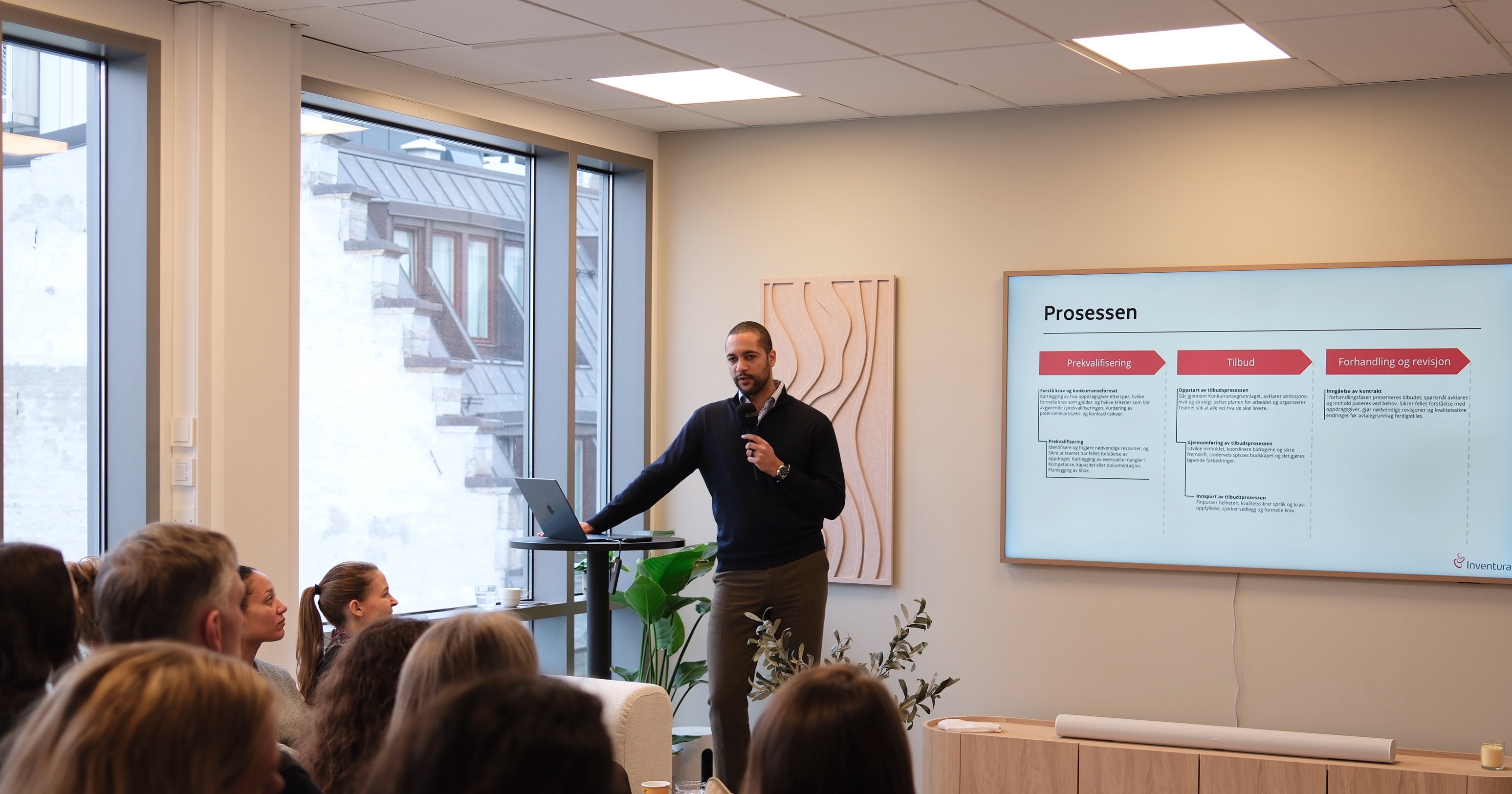
Thomas Tinnesand from Inventura shared practical experiences with AI in tender work, and explained why domain expertise, not generic AI text, is what still determines who wins.
Inventura is one of the leading professional environments in procurement and supplier management in Norway, with 140 consultants and a four-digit number of procurement processes last year alone. When Thomas Tinnesand, partner and head of sales and marketing, shares his observations from the field, it is worth listening. At Cobrief's breakfast seminar on March 19, he gave a practical and grounded review of what actually works, and what does not, when AI is used in tender work.
Expert in the Loop, Not Just Human in the Loop
Thomas's most striking point was a nuance of the well-known concept "human in the loop." It is not enough to simply have a human involved, he said. It must be an expert involved. As a supplier, you know your products and services better than any AI model. That knowledge must be actively used to give the AI the right context; otherwise you end up with generic text and solution descriptions without professional substance.
The message was simple and clear: Don't let AI write for you. Let AI write with you.
What AI Is Good and Bad at in Practice
Based on Inventura's experiences with clients who use AI in tender work, Thomas drew a clear picture of strengths and weaknesses. AI works well for creating first drafts, improving existing texts, conducting fact searches, summarizing documents, and doing language reviews. It can also help compress content and model different scenarios.
But AI performs poorly if it is not fed with professional input. Without expertise in the loop, you risk hallucination, incorrect assumptions, and generic responses that do not stand out from competitors. And as Anne Buan had already pointed out, such errors can have legal consequences.
A practical tip from Thomas was that AI works best on small, clear text modules: one point per paragraph, clear messages, and concrete documentation of measures. Those evaluating the tenders need clarity, concise points, and quick relevance. And that is something AI can actually help you achieve, if used correctly.
A Step-by-Step Process That Still Applies
Thomas walked through a typical negotiated procedure from start to finish, showing that even with AI in the toolbox, the fundamental success factors remain the same. It starts with understanding what the contracting authority is requesting and what formal requirements apply. Then it is about freeing up the right internal resources, anchoring ambition levels and strategy, and coordinating contributions across professional disciplines.
He emphasized the importance of quality assurance, not just proofreading and language, but a genuine review ensuring all requirements are answered and that the tender has a coherent thread throughout. And for the negotiation phase, it is critical to send a team with the necessary mandates, who share a common understanding of what has been written in the tender.
Short and Long Term: Efficiency First, Differentiation Later
Thomas concluded with a useful distinction between short-term and long-term gains. In the short term, AI primarily contributes to efficiency, but not necessarily differentiation. To stand out, good foundational concepts, structure, and active human guidance are still required.
In the longer term, he sees the greatest potential when internal domain knowledge is better structured and connected to AI, so that tools can take over more of the routine work. But coherence, prioritization, and competitive logic will for the foreseeable future remain a core human task.
Thomas Tinnesand is partner and CCO at Inventura, one of Norway's leading professional environments in procurement and supplier management. He presented at Cobrief's breakfast seminar on March 19, 2026.