New climate and environmental considerations in tenders: How your company is affected

From 2024, public procurement must weigh climate and environmental considerations at a minimum of 30% to promote sustainability. After half a year with the new rules, we share observations and show how Cobrief uses AI to interpret the climate and environmental weighting.
New rules in 2024
From 2024 onwards, public procurement must weigh climate and environmental considerations at a minimum of 30%. The goal has been to help reduce emissions and promote sustainable solutions. For some sectors, this has a significant impact, while for others the effect is minimal.
It has now been half a year with the new rules, and we have made some simple observations that we share in this article. At the very bottom, we also show you how easily Cobrief finds and interprets the climate and environmental weighting for you using AI.
Practical consequences in different sectors
For simplicity, we have divided into two areas -- sectors where climate and the environment have high significance and sectors where it has low significance. An important thing to note is that although the main rule is that climate and the environment should be weighted at a minimum of 30%, the buyer has the option to assess whether it should be an award criterion, or one or more requirements that together make up the weighting. The buyer can also determine that the procurement has an insignificant impact, and can therefore choose not to include climate and the environment as part of the evaluation.
High significance: Typically suppliers who sell something physical or build something
For suppliers of physical products such as office supplies, or physical non-digital services, we see that climate and environmental requirements are often important.
When selling a physical product where the contracting authority has included the environment as an award criterion, it typically states that the supplier must ensure that the products are environmentally friendly and sufficiently labeled. Factors such as recycling schemes, reuse, and recycled materials in the products often count positively in the evaluation -- in addition, suppliers are often encouraged to describe measures that reduce climate and environmental impact, such as energy supply from renewable sources and reduction of emissions in the transport chain.
In cases where climate and the environment are included as a qualification requirement, we typically see specific requirements for environmental certifications such as the Nordic Swan Ecolabel or EU Ecolabel, or other specific requirements that together can be assessed to constitute a weighting of 30%.
For procurements where something is to be built, such as in the construction industry, where the contracting authority has climate and the environment as an award criterion, it is often desirable that the construction site has low emissions and that the materials used are environmentally friendly. Typical positive measures include the use of electric machinery, biogas, and environmentally certified materials for insulation, concrete, steel, and wood. In addition, reuse, rehabilitation, and a good description of other measures that reduce climate and environmental impact are useful.
In cases where climate and environmental requirements are included as a qualification requirement, we typically see specific requirements for electric machinery, environmentally certified materials, and rehabilitation. Together, these can be assessed to constitute a weighting of 30%.
Low significance: Typically suppliers who sell services, often digitally
For suppliers who sell services, especially digital services, the climate and environmental impact is often considered minimal. Examples of such services include consulting services, legal services, and other administrative services that are primarily performed in an office setting.
However, we have seen several examples of procurements where climate and the environment have been weighted at 30% either as an award criterion or as more specific qualification requirements. Here we see that measures such as reduced energy consumption (with energy from renewable sources), travel activity, and waste management are often recurring.
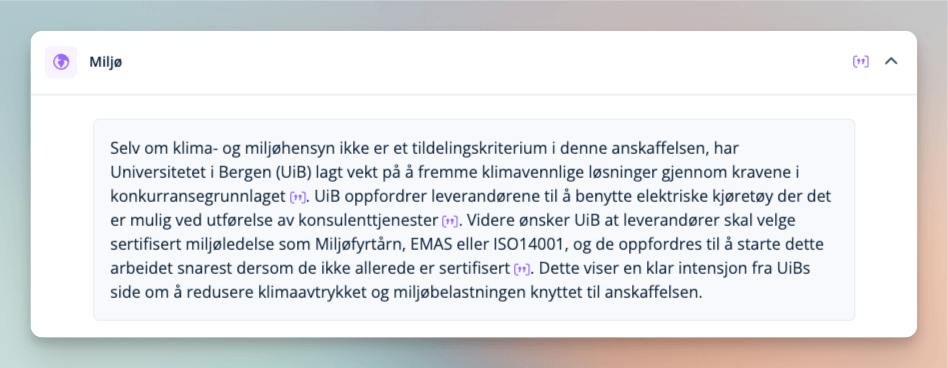
For example, there may be requirements for Miljøfyrtårn, EMAS (Eco Management and Audit Scheme), or ISO14001 (Environmental Management Systems (EMS)). There may also be requirements that the work should be delivered remotely, or an explanation of how cloud services used in connection with an IT project affect climate and the environment through energy use.
Even though the contracting authority today does not always choose to include climate and the environment as a criterion or requirement, we recommend being proactive going forward, as we see greater awareness in the public sector. It will in any case be positive to mention how your business takes climate and the environment into account when responding to any tender.
Cobrief interprets the climate and environmental weighting for you
Our AI scans through the tender, gives you an overview of the most important points, and organizes the information in a language you understand -- making it easy to see how climate and the environment are evaluated.