Breakfast Seminar: How Should You Work with Public Tenders in the Future?
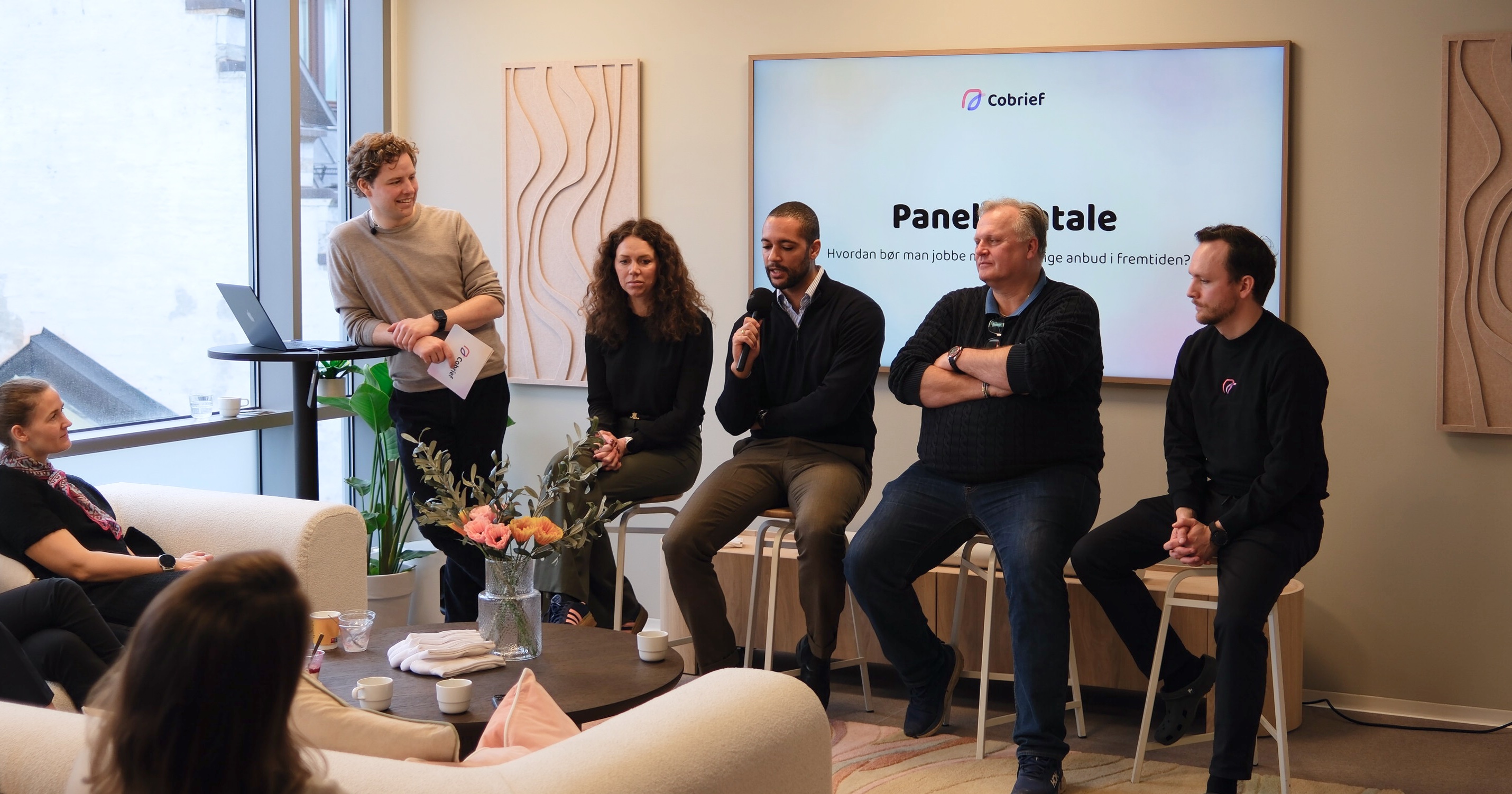
Cobrief hosted its first breakfast seminar at its own offices, featuring three of Norway's most experienced tender experts. The topic was the future of tender work, and how AI is changing the rules of the game for both suppliers and procurers.
With croissants on the table, a packed room, and a solid crowd joining digitally, we heard from three of the most experienced voices in public procurement in Norway: Christian Martinsen from Bonka, Anne Buan from CMS Kluge, and Thomas Tinnesand from Inventura. All with different perspectives, but sharing one observation: AI has already changed tender work, and the pace of change is accelerating.
AI Makes It Easier to Submit, but Harder to Win
A recurring theme across all three presentations was the paradox that AI has created in the tender market. Christian Martinsen put it into words right from his opening talk: AI has made it easier to submit proposals, but harder to win them. When everyone is lifted to a higher level, the old points of differentiation disappear. And as he warned: Uncritical use, where you upload, generate, and submit without adding anything of your own, leads to bland proposals that are virtually indistinguishable from one another.
Anne Buan from CMS Kluge confirmed this from the legal perspective. She is already seeing an increase in the number of proposals submitted, and the overall quality has become more uniform. The consequence? It is becoming harder for procurers to differentiate between suppliers, which creates new legal challenges around evaluation and justification of award decisions.
Thomas Tinnesand from Inventura added an important point: Subject matter expertise must remain the driving force. Don't let AI write for you, but with you. The winners going forward will be those who combine AI efficiency with genuine domain expertise and strategic thinking.
The Panel Discussion: More Dialogue, Fewer Writing Exercises
After the presentations, we brought all three speakers together with Cobrief CEO Jonas Klafstad for a panel discussion. This is where the real debate took off.
A central theme was how the evaluation of proposals is going to change. Anne Buan predicted a shift toward more verifiable criteria such as certifications, documented results, and demonstrations, rather than soft, text-heavy criteria like assignment understanding and methodology. Christian Martinsen cautioned, however, that this could weaken the capacity for innovation and reduce procurement to binary checklists.
The conversation also turned to whether we will see more two-stage processes with pre-qualification to handle the growing volume of proposals, and whether procurers will adopt more dialogue, demonstrations, and interviews as part of the evaluation. Thomas Tinnesand pointed out that while this is desirable, it is extremely resource-intensive, and time is often what procurers have the least of.
Jonas Klafstad threw in a provocative question: What happens when AI models become so capable that you can effectively generate ten proposals in one minute? At that point, you need to approach tender work at an entirely different level, more strategic and more human. Christian Martinsen agreed with the direction but emphasized that refinement and contextual understanding will remain critical.
The panel also touched on international competition and the fact that Norway is considered one of the least competitive tender markets in Europe. AI could potentially lower the barriers for foreign players, but cultural understanding and local knowledge will continue to play a decisive role.
An important point from Anne Buan was data security. Many suppliers share sensitive information with AI tools without considering the consequences. Christian Martinsen shared the same concern, particularly for competitions with security requirements and confidential documents.
The Road Ahead
The breakfast seminar made it abundantly clear that AI is not just a tool, but a force reshaping the entire tender process, from the supplier side to the procurer side, and from the legal framework to day-to-day practice.
The message from all panelists can be summed up as follows: Use AI for what it does well, namely analysis, structure, and efficiency. But remember that it is still humans who understand context, build relationships, and make the strategic decisions that determine who wins.
At Cobrief, we look forward to continuing this conversation throughout 2026. Do you have suggestions for what we should cover at the next breakfast seminar? Send us a message!